Sarah searches for Dinah Singleton
Down Cemetery RoadSarah Trafford’s search for Dinah Singleton begins as an attempt to reach a four-year-old child in hospital and becomes an inquiry into a disappearance that official records cannot explain. Its decisive turn comes when Sarah learns that Dinah is no longer there: the question is no longer simply whether an injured child is all right, but who has taken her, why, and what dangers attend trying to find her.
The hospital visit
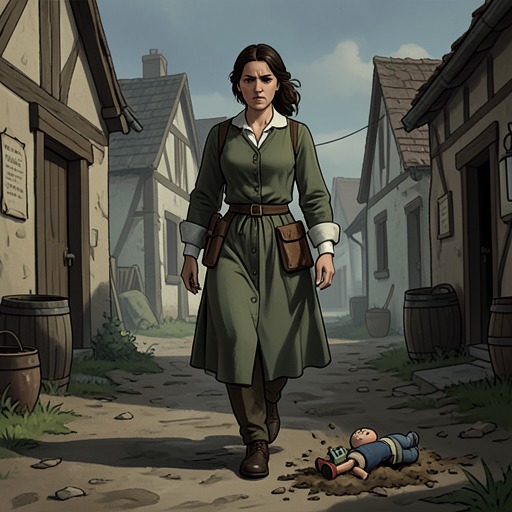
The search starts against a background of news that makes the local tragedy seem easy to push aside. Headlines are occupied by Iraqi troops, Western policy, and renewed accusations about missing Iraqi soldiers. Sarah sees the contrast plainly: international events elsewhere appear to matter more than two deaths and one small child nearby. She locks her car and goes into the hospital, refusing the distance that the headlines make possible.
At reception, one harried woman is managing three telephones and a short queue. Sarah asks to see Dinah Singleton, explaining that she does not know the ward but assumes it may be the children’s ward. She identifies Dinah as the little girl brought in after an explosion. Asked whether she is a relative, Sarah first calls herself a neighbour and then adds that she is a friend. The correction makes her connection sound more personal, but it does not give her the formal standing of family.
The receptionist tells Sarah to sit while she looks for someone who can speak to her. Sarah waits, but sees no obvious effort to find anyone. The hospital’s posters warn against smoking, drinking, drugs, and sex; their admonitory routine sits uneasily beside the danger Dinah has already survived. Sarah reflects that the child could grow up and encounter countless risks, yet might never again be as close to death as she was in the explosion. The thought shifts the search from a practical errand toward a question of what survival obliges others to do: Dinah has come through an extraordinary danger, and Sarah cannot treat that fact as a reason to leave her alone.
A disappearance inside the records
Sarah presses for a basic answer about Dinah’s condition. The hospital representative says she has no information on the patient. Sarah asks why, and the answer is that the patient is no longer in the hospital. The phrase offers no explanation: Dinah may have been transferred or discharged, but Sarah cannot establish which. When Sarah asks whether the woman is actually in charge, the woman insists that all enquiries will be dealt with by her. Authority is asserted at precisely the moment when useful information remains unavailable.
The uncertainty becomes more troubling when Joe Silvermann investigates. He has been to the hospital, though he says he gathered information at the nearby White Horse, a pub popular with medical staff. His account turns on an incongruity: hospital records are exceptionally precise, recording Dinah’s admission at 2:37 a.m. on the fourth, but provide no explanation for her disappearance in the middle of the night. The institution can account for the details of a patient’s stay and still fail to account for the child herself. In the search, meticulous documentation does not resolve absence; it makes the missing entry more conspicuous.
Sarah’s question about whether Dinah is all right therefore has no reassuring answer. The discovery that she has left the hospital changes the scale of the search. It is no longer enough to find the right ward or speak to a responsible official: Sarah needs to locate a child whose movements have become opaque even though the hospital kept exact records of her arrival.
Enlisting Joe Silvermann
Sarah goes to Joe Silvermann because she wants someone found. Joe describes how difficult it is to disappear completely in a world of records, credit cards, and traffic surveillance, then learns that the missing person is a four-year-old girl. Sarah rejects his offer to analyze the problem instead of acting on it. She wants to find Dinah Singleton, and Joe agrees to take the case under a standard contract: one day’s pay as a retainer, with the matter to be discussed again if he has not found the child within two days. Sarah fills in the form, including her address and current unemployment, and pays him.
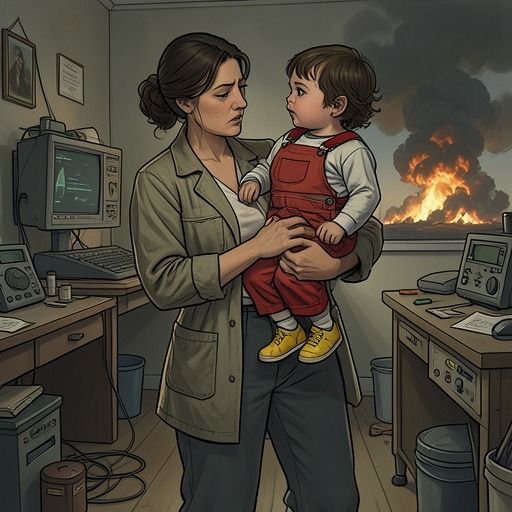
Joe’s early investigation produces a hospital admission time, not a location for Dinah. He later warns Sarah that the case is not as straightforward as finding a missing child. Dinah’s mother was killed in an explosion, and Dinah disappeared afterward; to Joe, that sequence suggests that someone has an enemy. Sarah objects that these facts alone do not tell her enough, but the warning establishes that the search may implicate people with power and a reason to conceal what happened.
From a missing child to a dangerous inquiry
The nature of that danger emerges through what Joe tells Sarah about the explosion. He says it was no accident: a bomb was involved. He also warns her that the matter concerns national security and military intelligence, and that private investigators are unwelcome in such territory. His caution gives the search a new dimension. Dinah’s disappearance is connected not merely to a family bereavement but to events that may be protected by official secrecy; continuing could expose both investigator and client to consequences beyond ordinary police attention.
Sarah tests whether Joe would help if she thought she knew where Dinah was. He emphasizes the danger, but she says she does not care about it and wants to find the child. Her determination is not presented as confidence that the search will be safe or simple. It rests on her understanding of Dinah as a survivor: Sarah had first imagined the explosion as an act of God, but now understands that the child has survived an act of human violence. That distinction makes indifference harder to accept. Dinah deserves, Sarah thinks, someone who cares about what happens next.
The search also opens onto testimony about the violence surrounding the case. In an account given to Sarah, a soldier recalls being taken into the desert and told that the boy soldiers they encountered were enemies, though they had been ordered to bring them back alive. The attack that followed sounded like glass breaking; the air changed, and the men experienced prolonged, excruciating pain. The speaker then describes looking up and seeing the boys melting. This testimony makes the danger behind Dinah’s disappearance more than a matter of vague official resistance: the surrounding history includes a concealed experiment and the killing of children.
The same account reveals that surviving soldiers were taken to an island off Scotland’s west coast and repeatedly told they would soon go home. They eventually learned that the guards knew they were officially supposed to have died in a helicopter crash near Cyprus. Their imprisonment, and the false account of their deaths, show how an institution could make people disappear while maintaining an authoritative record of what had happened to them. That pattern gives the search for Dinah a grim echo: hospital documentation records her arrival but not her departure, just as official declarations of death conceal living prisoners.
The search’s widening stakes
Sarah’s pursuit is driven by the immediate absence of one child, but its significance widens as the people around her disclose what the explosion and disappearance touch. The story moves from a crowded reception desk, where Sarah cannot even learn whether Dinah is well, to a private investigation constrained by warnings about military intelligence, and then to testimony about desert violence and secret detention. Each step replaces a simple explanation with a larger field of concealed actions.
The search does not begin with proof of who took Dinah or where she is. Instead, its early force comes from the gap between what can be documented and what remains hidden: Dinah’s exact time of admission, the unexplained fact that she is no longer at the hospital, and Joe’s discovery that the explosion was a bomb. Sarah’s insistence supplies the action’s moral centre. She continues not because the evidence has made the outcome certain, but because the child’s survival cannot be allowed to become another reason for the world to move on.